

Permanent installation with historical objects, tools, repurposed industrial parts, and a sculptural intervention in metal
The first core of Usina de Arte grew out of José Rufino's perspective on the remains of the former Santa Terezinha. The airplane hangar, filled with idle machines, machetes, and gears, became an installation devoted to the memory of work at the mill. On the façade, Tempus Fluvium traces the course of the Jacuípe River from its source to its meeting with the Una River, using nuts, bolts, and wrenches collected on site. The riverbed flows into an iron chair that refers to the founder of Santa Terezinha, José Pessôa de Queiroz, interweaving time, nature, and power.
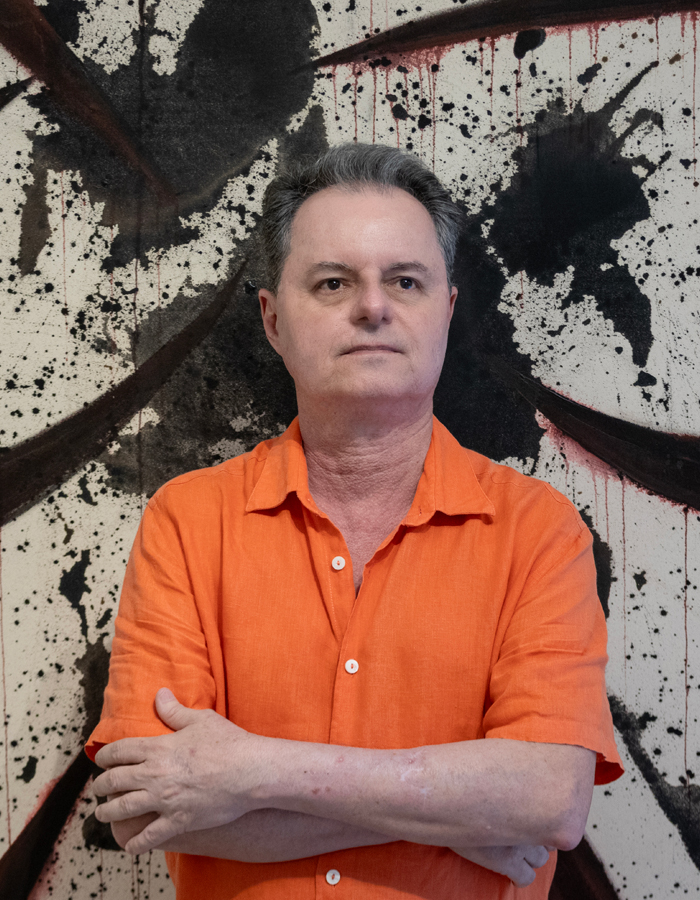
José Rufino
João Pessoa, Paraíba, Brazil, 1965
Lives and works in João Pessoa
At Usina de Arte: Hangar José Rufino and Tempus Fluvium (2015-2016)
Artist, professor and PhD in geosciences, he works in João Pessoa, where he was born in 1965. He began his career in the 1980s with poetry, mail art, painting and drawing, before moving on to large-scale installations. His work engages with memory, oblivion, opulence and decadence, in direct relation to the history of sugarcane in the Northeast of Brazil.